
When you manage a sterile processing department (SPD) or an endoscopy suite, drying is often the bottleneck in your decontamination cycle. Cleaning and thermal disinfection receive rigorous monitoring, yet instruments frequently sit on drying racks or emerge from washer-disinfectors with moisture trapped in lumens, hinges, and corrugated tubes.
Moisture is an active infection hazard. Investing in a dedicated Dekomed medical drying cabinet solves this vulnerability, protects your surgical inventory, and brings your department into alignment with strict decontamination standards.
The Microbial Danger of Residual Moisture
 Bacteria require water to multiply. Many people fail to realise that any moisture which is left on medical instruments, anaesthetic tubing, or endoscopes after disinfection enables any surviving vegetative bacteria to reproduce within hours.
Pseudomonas aeruginosa, an opportunistic pathogen common in water supplies, thrives in moist environments. When an instrument with a damp lumen sits overnight at room temperature, bacteria double every 20 to 30 minutes. By morning, a single organism becomes a colony of millions, secreting extracellular polymeric substances that form biofilms. Once a biofilm forms inside a lumen, standard washing cycles often fail to strip it away during subsequent reprocessing.
Dekomed drying cabinets remove this risk by circulating medical-grade, HEPA-filtered hot air throughout the chamber. The forced air reaches the interior surfaces of narrow lumens and corrugated surfaces, evaporating water before microbial colonies can establish themselves.
Meeting Compliance and Validation Standards
Decontamination is heavily audited. Health authorities and accreditation bodies do not accept ad hoc drying methods like leaving trays on open counters or using compressed air lines.
In the UK and Europe, standards such as BS EN ISO 15883 and Health Technical Memorandum (HTM) 01-01 require a validated, repeatable decontamination process. Drying is an explicit component of this validation chain. If your audit logs show that an instrument was disinfected at 90°C for one minute, but you cannot verify how or when that instrument dried, your audit trail breaks.
Dekomed drying cabinets have been exhaustively designed to ensure that you, as a user, have precise control over every aspect of the drying cycle:
- Filtered Air Supply: The drying system involves drawing air into the cabinet and, in the process, passing it through an H14 HEPA filter. As a consequence, this removes 99.995% of airborne particles down to 0.3 microns. This eliminates the risk of recontaminating clean items with ambient hospital room air.
- Controlled Temperature Settings: Dekomed medical drying cabinets give you precise control over temperature settings, enabling you to set the temperature between 40°C and 80°C depending on your load. This flexibility enables you to process heat-sensitive plastics alongside heavy stainless steel sets without the risk of degrading materials.
- Digital Cycle Tracking: In addition, microprocessor controls give you the flexibility to program cycle runtimes anywhere between 15 and 90 minutes. You can log parameters for each batch, giving your infection control team complete traceability.
Overcoming the Anaesthetic and Respiratory Tubing Problem
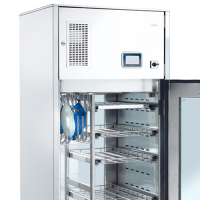 Breathing circuits, anaesthetic bags, ventilator tubes, and suction lines are among the most difficult items to dry manually. Their corrugated walls trap droplets in dozens of ridges. Hanging them on ambient racks leaves moisture trapped in the folds for 12 to 24 hours.
Using medical compressed air to blow out tubes by hand is time-consuming and introduces occupational risks. High-pressure air can generate pockets of residual moisture, in turn exposing technicians to airborne droplets. Another significant risk is that hospital compressed air lines can contain trace amounts of compressor oil or condensation if line filters degrade due to poor maintenance scheduling.
Dekomed cabinets resolve this problem with the use of purpose-built internal racks:
- Tube Hanging Manifolds: Dedicated nozzles fit inside corrugated tubes. These are then used to blow HEPA-filtered warm air directly down the interior channel, while at the same time external airflow dries the ridges.
- Mask and Accessory Baskets: Modular wire baskets hold masks, connectors, and resuscitation bags in positions that prevent pooling.
- High Capacity: A full-size cabinet handles up to 45 anaesthetic tubes or 10 full breathing sets in a single 45-minute cycle.
Your technicians load the batch, close the door, and walk away to handle other decontamination tasks.
Reducing Instrument Turnaround Times
 Surgical delays often trace back to missing instrument sets. Orthopaedic drills, laparoscopic sets, and specialised optics carry high purchase costs, so hospitals buy limited quantities. When your operating theatres run back-to-back lists, you cannot wait hours for instruments to air-dry.
A washer-disinfector includes an internal drying phase, but relying solely on the washer for complete drying reduces your overall department throughput. If a washer spends 30 minutes drying a load, other dirty loads queue outside the machine.
You increase your department capacity by unloading damp instruments from the washer immediately after the thermal rinse and transferring them into a Dekomed cabinet. This practice keeps your washer-disinfector focused on washing and disinfection cycles.
Consider the mathematics of a busy four-theatre hospital unit:
- Moving drying to a dedicated cabinet saves roughly 25 minutes per washer cycle.
- Across six washer cycles per day, you recover 150 minutes of wash capacity per machine.
- You process three to four additional wash batches per day without purchasing an extra washer-disinfector or expanding your plumbing infrastructure.
Preserving Your Medical Instruments’ Longevity
Water quality and prolonged controlled drying times damage expensive surgical instruments.
When tap water or even softened rinse water sits on stainless steel surfaces, minerals precipitate as the water evaporates slowly. This leaves white chalky spots and mineral deposits that can bind joint mechanisms and cause box locks to stiffen. In worst cases, lingering water beneath trapped debris creates galvanic corrosion and pitting, which weakens the metal and creates pits where bacteria evade future cleaning.
Rapid, uniform hot-air drying prevents these mineral deposits from settling into the steel. Dekomed cabinets circulate warm air at high velocity, evaporating pure moisture rapidly and preventing water staining. This delivers reliable performance time and time again.
Practical Features That Simplify Daily Operation
Equipment must fit the physical realities of your reprocessing room. Dekomed designs cabinets with several functional details that make daily use practical:
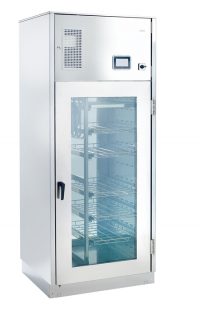
- Double-Glass Insulated Doors: Technicians can inspect loading status and cycle progress visually without opening the door and dumping heat into the room.
- Pass-Through Configurations: If you operate a partitioned facility with a clean packing room separated from the wash area, pass-through models allow loading from the dirty/wash side and unloading into the clean packing zone.
- High-Grade Stainless Steel Construction: Chambers use AISI 304 or 316-grade stainless steel with curved internal corners, making the cabinet itself easy to wash down and disinfect.
- Audible and Visual Alarms: The system alerts technicians to filter saturation, temperature deviations, and cycle completions, preventing human error from compromising a load.
Treating drying as an afterthought compromises every cleaning and disinfection step that comes before it. A Dekomed drying cabinet provides the temperature control, air purity, and cycle speed required to protect patients from healthcare-acquired infections, extend the service life of your medical devices, and keep your theatre schedules running on time.
If you are in the market for a medical drying cabinet and need to discuss your requirements further, then please contact our friendly customer service team today on (0)161 483 7333. They will be happy to answer any and all of your questions and provide guidance to ensure you purchase the best device for your personal requirements.