 Manual instrument scrubbing carries real risks. Every time your staff uses a brush over a decontamination sink, they risk splash exposure or sharps injuries. Beyond the safety hazards, human cleaning is variable. One person scrubs for two minutes, another for thirty seconds, and water temperatures change as taps run.
For busy dental practices, veterinary surgeries, podiatry clinics, and outpatient departments, automated thermal disinfection removes that human variability, delivering effective cleaning time after time. Yet many practices avoid automated washer disinfectors because they assume the machines require a commercial-kitchen footprint.
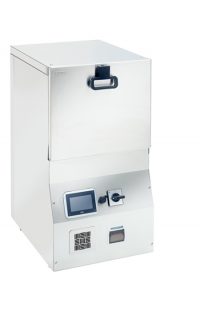
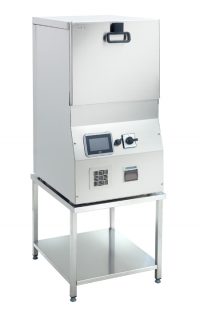
Dekomed delivers the ideal solution for this problem with its compact range, led by models like the DEKO D25ix. These machines provide high-level disinfection while sitting neatly on a standard benchtop, dedicated cabinet, or under-counter space.
The Footprint Problem in Local Decontamination Units
 Space is usually the biggest obstacle when upgrading a decontamination room. Most practices operate out of converted rooms where every centimetre of counter space matters. You have dirty receiving areas, sinks, inspection lamps, autoclaves, and packaging zones all competing for surface area.
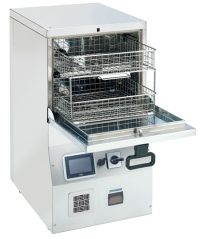
The DEKO D25 series tackles this by keeping its outer width to just 460 mm. With an outer depth of 580 mm and height of 845 mm, it fits on sturdy workbenches, sits under standard counters, or rests on a dedicated stand.
Despite this modest footprint, the internal chamber provides a 40-litre gross volume. That is enough capacity to process the daily rotation of handpieces, mirrors, forceps, and hollowware for a busy practice running one to three treatment rooms. You do not sacrifice throughput for size, or indeed cleaning and disinfection performance.
How the Automated Cleaning and Disinfection Cycle Operates
A washer-disinfector does not simply rinse tools in hot water. It follows a multi-stage process designed to strip organic debris before applying heat. If you apply high heat immediately to blood or tissue, proteins coagulate and bake onto stainless steel surfaces, creating a biofilm barrier that makes removal of the debris even more difficult and challenging.
Dekomed small benchtop units eliminate this problem through a structured sequence:
- Cold Water Pre-Rinse: Flushes away gross contamination, heavy debris, and blood before proteins denature.
- Detergent Wash: When it comes to adding detergent, it is important for an efficient wash that the precise amount of chemical dosing is applied to effectively break down lipids and any remaining organic matter.
- Warm Rinse: Having introduced detergent into the process, it is equally important that any detergent residue is completely removed from the instrument surfaces.
- Thermal Disinfection: Although it is critical to add the chemical detergent, equally important is the water temperature, which must be 90°C. Dekomed disinfectors then hold that temperature for a controlled duration to hit verified A0 disinfection parameters.
- Drying: Having gone to all the effort of cleaning your instruments properly, the next critical step in the process is to have an efficient drying process. Once the wash cycle has been completed, Dekomed washer disinfectors circulate warm air through the chamber, ensuring that all your medical equipment emerges dry, reducing corrosion and preparing items for direct packaging.
Dekomed units use high-output circulation pumps. In the DEKO D25 series, the pump circulates up to 260 litres of water per minute. That pressure forces water through rotating spray arms and dedicated wash racks built for hollow instruments, cannulas, and rigid scopes.
BS EN ISO 15883 and HTM 01-05 Standards – The Requirements Your Dental Practice or other Medical Facility Must Meet
If your medical facility is in the UK or Europe, then your decontamination processes must comply with a set of standards. If, for example, you operate a dental practice, then guidance documents such as HTM 01-05 explicitly state that automated washer disinfection is the preferred method over manual cleaning. Dekomed benchtop machines comply with BS EN ISO 15883 parts 1 and 2, alongside IEC 61010-2-040 for electrical safety.
The other issues you need to take into consideration when cleaning contaminated instruments are that you need some way of proving that you are meeting compliance standards. If you are inspected, when the inspector reviews your records, you cannot simply say that you have washed your dental equipment to the specified standard. Dekomed programmable logic controllers log time, temperature, and cycle phases continuously. Additionally, should you want or require it, you can connect external loggers or printers to keep traceable, audit-ready records for every single load. The control panel also shows remaining cycle times and process parameters clearly, so staff can see cycle status at a glance.
Real-World Time and Cost Savings For Medical Facilities
Consider a dental clinic processing 12 instrument trays a day. If dental nurses clean those trays manually, they must:
- Fill wash sinks to controlled temperatures.
- Dose enzymatic detergents manually.
- Scrub each instrument individually beneath the water line to suppress aerosols.
- Rinse thoroughly.
- Dry each instrument with non-linting towels.
- That manual routine consumes 15 to 20 minutes per tray of uninterrupted staff time, equalling three to four hours of labour every day.
- When you switch to a DEKO benchtop unit, the physical process shifts:
- Staff place dirty instruments directly into the wire baskets.
- They close the door and press start.
- The automated cycle takes over.
 Staff invest two minutes loading and unloading. That returns roughly three hours of nursing time back to chairside patient care, administrative coordination, and stock control every working day.
Sharps safety also improves dramatically. Handling wet, slippery scalpels and probes with brushes creates frequent puncture incidents, with the risk being automatically removed by using a Dekomed washer-disinfector.
If you are currently researching a washer-disinfector, then Dekomed is recognised as the brand leader in the United Kingdom. We have many years of experience, invest significant amounts in research and development, and our staff are always on hand to give guidance and advice to aid your purchasing decision.
For more information or to get the answers to any questions you might have, feel free to contact our customer service team on (0)161 483 7333