 If you manage a clinical decontamination room, dental practice, or surgical unit, instrument cleaning is a daily battle against time and contamination. You must clean every tool thoroughly before sterilisation because residual blood, proteins, or bioburden can shield microbes from the autoclave.
Yet many facilities still rely on manual scrubbing at the sink. Technicians stand over basins with brushes, scouring scalpels and cannulas by hand. While manual cleaning feels familiar, it creates serious occupational hazards, inconsistent results, and weak spots in your infection-control chain.
Automated washer disinfectors, such as those engineered by Dekomed, replace manual uncertainty with a sealed, mechanically validated process. Examining differences in staff safety, process consistency, and clinical infection control shows why modern healthcare standards continue to phase out manual scrubbing.
Eliminating Sharps Injuries and Splash Hazards
The primary danger in manual cleaning sits right in the sink. When staff scrub contaminated instruments, they directly manipulate sharp blades, dental burs, explorers, and bone curettes. And the more cleaning happens in a bowl or sink full of water, the dirtier that water becomes, making it harder for your staff to see the instruments and clean them properly.
Sharps injuries can cause catastrophic problems for both your staff and your medical facility. A simple puncture wound, which can happen in a split second, could potentially expose your member of staff to bloodborne pathogens, such as Hepatitis B, Hepatitis C and HIV. Your organisation would then have a significant duty of care to that team member, including but not limited to urgent occupational health visits, post-exposure prophylaxis, and the anxiety and stress your staff member will experience while awaiting the results.
However, there are additional concerns beyond a puncture wound. Manual scrubbing, by its very nature, creates infectious aerosols and fluid splashes. As your staff member scrubs, fine mists of contaminated water are released into the air. These minuscule droplets can land on PPE, scrubs, and surrounding counter spaces. While your protocols and SOPs may require scrubbing below the water line, the reality of a human workforce is that mistakes can and will happen.
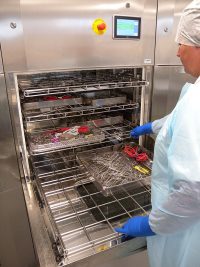
Dekomed washer disinfectors, such as the compact DEKO D25ix or the larger DEKO D32 series, keep staff hands out of harm’s way.
- Direct loading: Staff place contaminated instruments into dedicated wire baskets or racks immediately at the point of care or upon reception.
- Hands-off processing: Nobody scrubs sharp edges with brushes. The technician slides the tray into the chamber, seals the door, and presses start.
- No direct chemical handling: Automated systems dose enzymatic detergents automatically from secure reservoirs. Your team does not mix chemical solutions or breathe in chemical vapours.
By isolating bioburden behind heavy-duty, acid-proof stainless steel doors, you eliminate routine sharps handling and contain splashes.
Replacing Human Variability with Repeatable Results
Manual cleaning relies on human consistency, and human performance fluctuates.
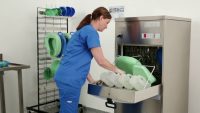 Consider what happens over an eight-hour shift. One technician scrubs an instrument tray for ten minutes in fresh solution; another rushes through in three minutes because the clinic is behind schedule. Sink water temperature drops from 40°C to room temperature as the basin sits. Enzymatic cleaners lose potency if water gets too cool, or they denature if water runs too hot. Complex items like hollow cannulas, suction tubes, and box-lock hinges are skipped or brushed only superficially because bristles can’t reach narrow lumens.
The biggest issue with any manual cleaning process, no matter how dedicated and professional your staff are, is inconsistent cleaning, which affects disinfection and sterilisation later in the process. In addition, you, as a manager, have no easy way to validate the process, which essentially depends on individual stamina, attention to detail, and visual inspection.
The beauty of using a Dekomed medical cleaning product is that it replaces human variability with automated reliability and consistency.
Every instrument processed in a Dekomed automated washer-disinfector receives identical treatment, morning or afternoon, load after load.
Higher Standards for Infection Prevention and Control
Modern clinical governance requires proof that equipment decontamination meets strict microbiological benchmarks. Manual cleaning cannot achieve true thermal disinfection; hot water capable of killing vegetative microorganisms would cause third-degree burns to an operator’s hands.
Dekomed units bridge the gap between gross decontamination and autoclave sterilisation through validated thermal disinfection.
True Thermal Disinfection
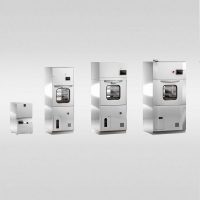 Manual sinks rely on ambient tap water, generally capped around 40°C to 45°C to protect workers and avoid coagulating blood proteins. Dekomed machines wash at target temperatures, then drive chamber water up to 90°C or higher for precise holding times. This heat generates an A0A0 value that inactivates vegetative bacteria, mycobacteria, fungi, and lipid/non-lipid viruses. When staff open the washer door, instruments are already disinfected and safe to handle for packaging, inspection, and autoclaving.
Data Logging and Audit Readiness
If a surgical or dental patient develops a post-procedure infection, your audit records come under scrutiny. With manual washing, you have no data trail beyond a tick mark in a paper logbook stating someone washed the tray.
Dekomed units incorporate digital monitoring. Onboard controllers track water temperature, pump pressure, and cycle duration throughout the run. You can export cycle files or connect to tracking networks, giving you verifiable proof that every batch met British and European standards (such as BS EN ISO 15883).
Practical Workplace Efficiency
Manual decontamination consumes enormous blocks of productive time. A staff member scrubbing, rinsing, and drying a standard tray of surgical instruments requires 15 to 20 minutes of continuous, dedicated attention. Over a workday with ten trays, that’s three hours spent bending over a wet sink.
When you introduce automated equipment:
- Staff spend roughly two minutes loading and unloading per basket.
- The automated system frees technicians to assist clinicians, prep procedure rooms, manage inventory, or support patient flow.
- Water and detergent consumption remain controlled per cycle, cutting wasted utilities compared to continuously running taps.
The Standard for Modern Clinics
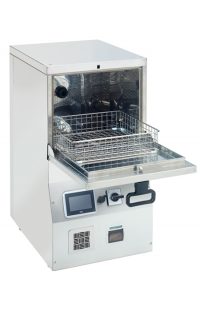 Manual cleaning was once an accepted necessity, but operating sinks for bioburden removal exposes your staff to avoidable hazards and exposes your practice to compliance vulnerabilities.
Dekomed automated washer disinfectors secure your decontamination workflow. They protect healthcare workers from sharps, prevent aerosol-based room contamination, and ensure every medical device meets verifiable thermal disinfection criteria before entering an autoclave. Automation gives your clinic repeatable results, protected staff, and rock-solid infection control.
If you have been tasked with purchasing an automated washer-disinfector, then you want to know that the product you ultimately recommend and choose will be reliable, efficient, and deliver consistent, reliable results time and time again. Call our friendly and knowledgeable customer service team today on 0161 483 7333