
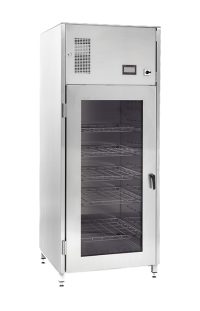
 In a world where every aspect of your business is scrutinised for cost savings and return on investment, it’s ironic that many medical facilities overlook the drying stage of sterile processing and decontamination. While big-ticket items like washers, disinfectors, and autoclaves get the headlines, drying isn’t an optional finishing step. In fact, you could argue that improper drying can completely undo all the good work that came before.
If any moisture remains on surgical instruments, flexible endoscopes, or respiratory tubing, you risk encouraging microbial growth, compromising sterility, accelerating equipment corrosion, and wasting valuable staff hours.
The simple, cost-effective solution is to invest in a Dekomed dedicated medical drying cabinet. This relatively small investment delivers measurable returns in three areas: infection prevention, device preservation, and departmental throughput. Let’s look closer at how the financial and operational numbers add up.
1. Infection Prevention: Eliminating the Reservoir for Pathogens
Moisture is the primary enabler of bacterial proliferation. Gram-negative bacteria such as Pseudomonas aeruginosa, Escherichia coli, and Klebsiella pneumoniae can double their population in under an hour when left in a warm, damp environment.
The Cost of Residual Moisture
When instruments or complex lumened devices emerge from a washer-disinfector, water droplets remain in internal channels and hinges. If staff pack damp instruments into sterilisation wraps, those droplets can cause:
- Wet packs: Moisture compromises the sterile barrier of wraps and pouches. Once moisture penetrates the wrap, wicking draws ambient bacteria through the porous paper, invalidating sterility. A wet pack cannot enter the operating theatre.
- Biofilm formation: Because of the complexities and intricate design of flexible endoscopes and respiratory hoses, residual moisture can easily enable surviving vegetative bacteria to form biofilms within internal channels. Once established, biofilms resist subsequent chemical disinfection and manual cleaning.
Calculating the Financial Impact
 Healthcare-associated infections (HAIs) place severe strain on hospital finances:
- In the UK, treating a single surgical site infection (SSI) costs the NHS between £4,000 and £10,000, depending on severity and bed days required.
- Biofilm-related cross-contamination incidents can ground entire endoscopy lists, requiring patient recalls, serological testing, and formal governance reviews that quickly run into tens of thousands of pounds.
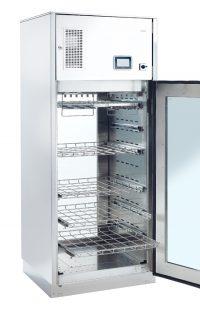
Our Dekomed medical drying cabinets use HEPA-filtered, temperature-regulated air directed through dedicated manifolds and connectors straight into internal lumens. By removing 100% of residual moisture inside and out, the cabinet stops microbial proliferation before devices reach storage or packaging. Avoiding just two wet-pack recalls or one SSI per year pays back the capital cost of a drying cabinet.
2. Device Protection: Extending the Lifespan of Sensitive Inventory
Surgical instruments and diagnostic scopes are expensive hospital assets. A single flexible video endoscope costs between £25,000 and £45,000, while a specialised robotic instrument set costs tens of thousands of pounds. Damp storage degrades these investments rapidly.
Corrosion and Mechanical Wear
Stainless steel resists corrosion because of a chromium oxide passive layer. Unfortunately, any stagnant water left behind, which is highly likely to contain mineral salts or chemical traces, then attacks the chromium passive layer. This then creates;
- Pitting and crevice corrosion: Small areas or spots of rust can form in joints, microcracks, or box locks.
- Blunt cutting edges: Scissors, rongeurs, and osteotomes, where a sharp cutting edge is essential for efficient use, lose their sharpness faster when stored damp, which not only reduces efficiency but also increases costs because they need to be replaced more often.
- Optics fogging and glue breakdown: Another significant issue is that endoscope lenses, adhesives, and channel linings are also much more likely to degrade when they are exposed to prolonged humidity.
The Cost of Premature Replacement and Repairs
Examples of annual repair expenditure:
- Endoscope repairs: Channel replacements and distal tip rebuilds cost between £3,000 and £7,000 per incident. A significant portion of fluid-invasion damage occurs because scopes enter storage cabinets with moisture still in the suction or air/water channels.
- Instrument refurbishment: Reprocessing departments often write off stainless steel sets due to staining, rust, or joint stiffness.
A Dekomed drying cabinet protects your inventory by providing a controlled environment. Adjustable temperature settings (typically 40°C to 70°C) give your staff the right options for delicate materials such as rubber seals, camera heads, optics, and plastics, letting them dry safely without thermal stress. By extending the usable lifespan of your instrument sets by 20% to 30%, you protect capital budgets and reduce ongoing maintenance costs.
3. Staff Efficiency: Reclaiming Hours in the Decontamination Cycle
Manual drying is slow, inconsistent, and labour-intensive. In many busy sterile services departments (SSDs) and endoscopy suites, technicians still use handheld compressed air guns or lint-free towels to dry instruments before wrapping.
The Problem with Manual Drying
- Compressed Air Inconsistencies: Medical-grade compressed air is expensive. Non-medical compressed air can introduce trace oils, pipe scale, and ambient moisture directly back onto clean instruments.
- Channel Access: Technicians cannot reliably verify that the middle section of a two-metre endoscope channel or a fine laparoscopic cannula is completely dry using an air gun.
- Repetitive Strain: Holding and operating compressed air guns for hours causes wrist and hand fatigue among processing technicians.
Measurable Time Savings
Consider a department processing 60 instrument trays and 20 endoscopes a day:
- Manual drying of a complex tray (cannulated items, hinged tools, modular sets) takes an average of 5 to 8 minutes.
- Manual channel flushing with compressed air takes 3 to 5 minutes per scope.
- That’s roughly 6 to 8 technician hours per day spent exclusively holding air guns and wiping surfaces.
When you install high-capacity drying cabinets:
- Staff load washed trays and connect scopes directly to internal air ports.
- The automated cycle runs unattended, circulating HEPA-filtered hot air through lumens and around baskets at the same time.
- Drying cycles complete in 15 to 45 minutes, depending on your load profile and device complexity.
Technicians spend that reclaimed time on inspection, tray assembly, and tracking documentation. You increase throughput without adding headcount, eliminate pre-autoclave bottlenecks, and ensure prompt turnaround times for surgical suites waiting on fast-track sets.
A Targeted Investment for Long-Term Value
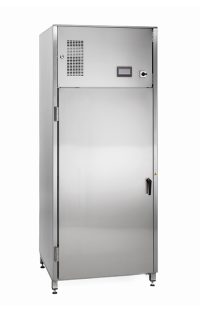 Don’t treat a Dekomed medical drying cabinet as an optional accessory. It is an operational necessity that directly influences patient safety, instrument longevity, and labour utilisation.
By eliminating the moisture that fuels bacteria, protecting expensive instruments from premature degradation, and automating hours of manual work, a high-performance drying cabinet pays for itself quickly. For clinic managers, SSD leaders, and procurement teams looking to improve decontamination standards, the business case is clear, defensible, and sound.
If you are in the market for a drying cabinet, then Dekomed are one of the acknowledged leaders in the industry. Our team are dedicated to developing, improving and delivering the best possible results for you, our customer.
If you have any questions or need advice or guidance, please contact our friendly customer service team today on (0)161 483 7333.